
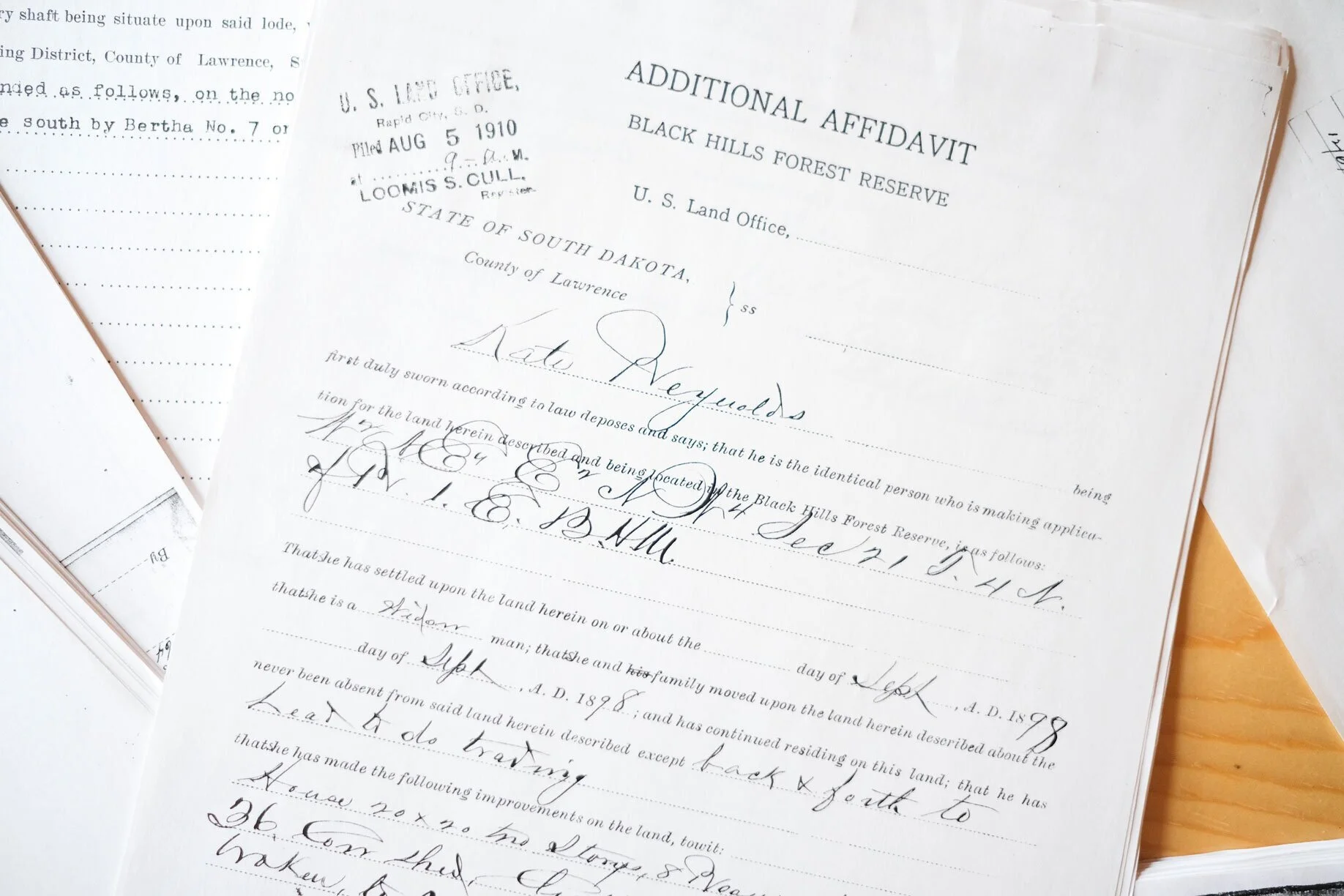
The stories that make up history have multiple layers. They often conflict and overlap creating a web of understanding with gaps we accept. These gaps, in my opinion, give us the space to interpret what was, what perhaps should have been, and what can inform the future. This is the story, or at least what is possible to be known, of land patent 0023727.
This land patent was issued on March 15, 1915 to Kate Reynolds for the “west half of the northeast quarter and the east half of the northwest quarter of Section twenty-one in township four north of Range one east of the Black Hills Meridian, South Dakota, containing one hundred sixty acres.” In the late 1800s, the Black Hills was a part of the great expansion and settlement of the West. Many people were drawn here first by the gold rush, which quickly dissipated, but stayed for the promise of land for ranching, agriculture, and the harvest of cordwood. As for Kate Reynolds, it is difficult to find and decipher much about her specific journey as she was a woman, an African American, and born a slave.
The little I’ve been able to find about African American homesteaders in the Black Hills, mostly references that people would often and intentionally omit racial information on legal and public documents. There are also some references to the main racial divider, at this time in the West, as being mainly between “Native Americans and everybody else.”
The Homestead Act of 1862 said, “That any person who is the head of a family, or who has arrived at the age of twenty-one years, and is a citizen of the United States, or who shall have filed his declaration of intention to become such, as required by the naturalization laws of the United States, (… reference), shall be entitled to enter on a quarter section or less quantity of unappropriated public lands.”
The process of homesteading started with selecting a parcel of land that was available, which would be confirmed by submitting an affidavit to the land office for the entry. Once confirmed available, the applicant would pay between $1.25 and $2.50 per acre and was required to reside on and improve the land consistently for the term of 5 years. This became known as ‘proving up’ a homestead. After this five year period, they would have to submit witness testimony of at least two neighbors or friends saying they had fulfilled the government requirement. At this point they would be issued the land patent showing private ownership.
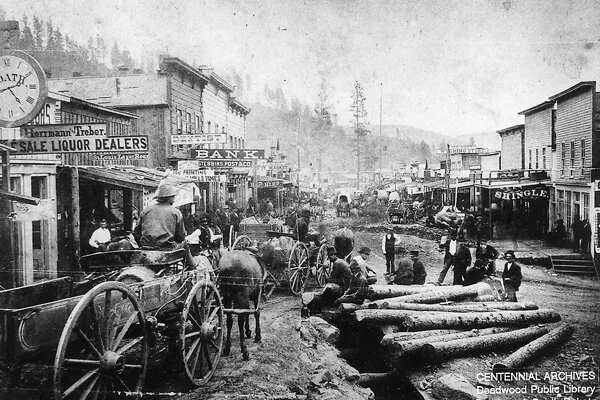
Deadwood City, Main Street, the summer of 1877
Kate Reynolds first moved to Deadwood with her husband, Pleasant Reynolds, and son, Clarence, sometime in the late 1870s. During this time she worked as a cook, midwife, nurse, boarding house manager and laundry worker. A local newspaper shows her name in reference to divorce proceedings, but as stated in her affidavit for the forest reserve above, she usually claimed being a widow. In the same affidavit, where she took the time to cross out or add an ‘s’ to all the he and his pronouns, she states having settled on her homestead entry in September 1898.
Even though there is little written about Kate from a personal stand point, she must have been as tough as they come. First, she would have been in her 50s when she applied for her homestead entry. Then, working with what we all know and accept about the rights of African Americans, former slaves, women, and worse yet, a possibly divorced woman, you can quickly imagine what everyday life might have been for her. Finally, add the resilience required to develop completely untouched land, build from scratch your home, and establish a cordwood business. All I can say is, Kate Reynolds is a true inspiration and an important founding member of this property.